Best Reverb Pedals 2026: Ranked for Studio and Stage
Reverb is the one effect almost every guitarist uses whether they realize it or not. Even a small amount of room reverb turns a dry, close-mic'd guitar into something that sounds like it exists in a physical space. A lot of reverb turns it into pure atmosphere. The question isn't whether to use reverb — it's which type and how much.
We tested five reverb pedals extensively, ranging from simple room-and-spring pedals to deep algorithmic processors. We've also covered the Strymon BigSky in its own full review if you want the deeper dive on that one specifically. Reverb also pairs closely with delay — see our best delay pedals roundup for pedals that work well alongside these.
Reverb Types Explained
Spring reverb is what a built-in amp reverb sounds like — a coiled spring physically vibrates and returns a bright, splashy echo. Classic for country, surf, and vintage blues. Sounds best at low to moderate amounts; crank it and it gets washy and loses definition.
Hall reverb simulates a large concert hall. Long decay times, wide stereo spread, the kind of reverb that makes a clean guitar part sound epic. Works well for lead lines and clean arpeggios. Can get cluttered at high gain.
Plate reverb simulates a large metal plate that was used to add reverb in recording studios before digital processing. Brighter and more diffuse than hall, with a unique "shimmer" that works on guitars, vocals, and piano.
Room reverb is a shorter, more natural ambience. Sounds like you're playing in a real room rather than a concert hall. Great for making a dry recording sound like a live performance without going obviously wet.
Shimmer reverb adds pitch-shifted harmonics to the reverb tail — usually an octave up. Not a natural room sound; it's a sound that was technically impossible before digital. Used extensively in ambient, post-rock, and worship music.
What to Look for in a Reverb Pedal
- Number of reverb types: More types gives you more options for different songs and sounds. But if you only need spring and room, a simple two-mode pedal is easier to use live.
- Decay control: Controls how long the reverb tail rings out. Essential for dialing in the right amount of "space" for a given song or venue size.
- Pre-delay: Adds a small gap before the reverb starts. Makes the dry signal more distinct in a mix. Very useful; not all pedals have it.
- Tone/damping: Controls the brightness of the reverb tail. Darker tails sit in a mix better. Brighter tails sound more sparkly but can clash with high-gain tones.
- Stereo I/O: Reverb in stereo sounds dramatically wider and more three-dimensional. Worth having if you use a stereo rig or record direct.
- Trails: When you turn the pedal off, trails mode lets the reverb decay naturally instead of cutting off. Always sounds better; check whether the pedal supports it.
The Rankings
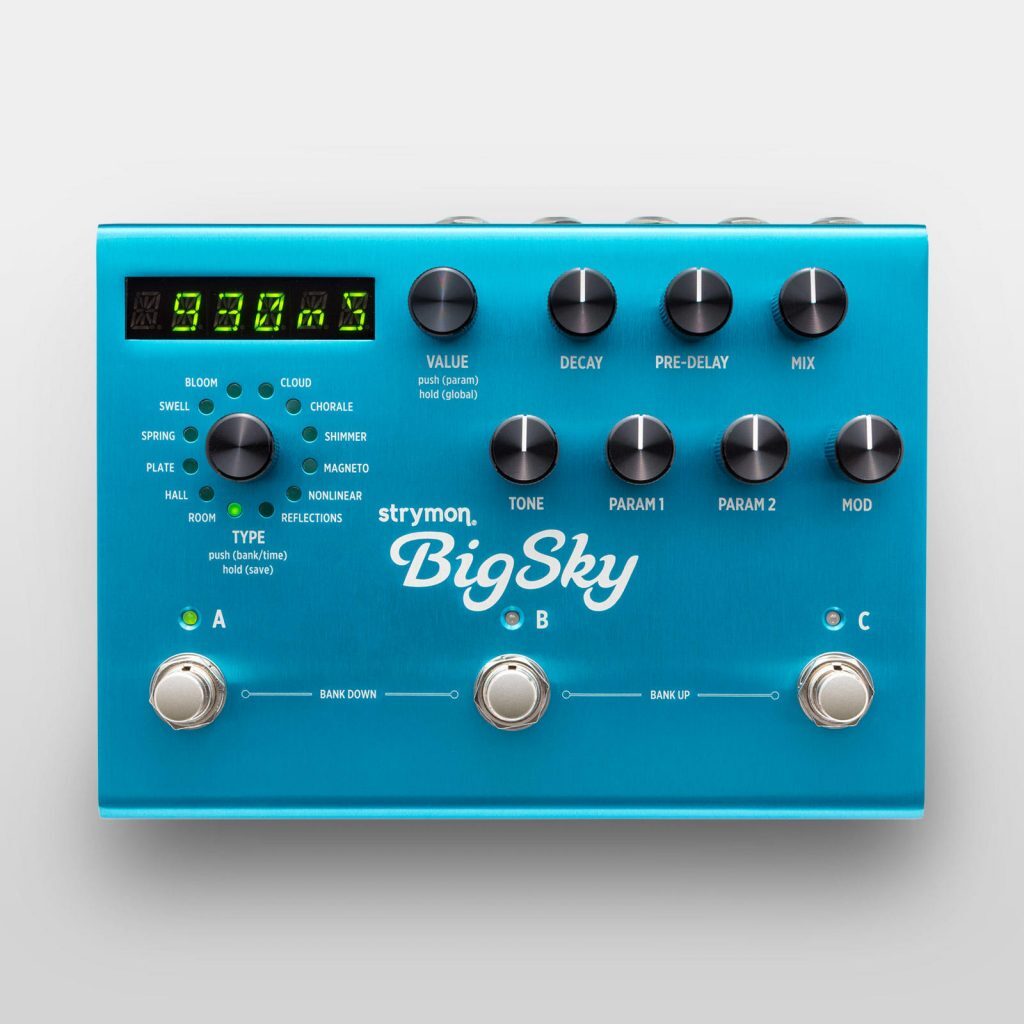
The BigSky remains the standard by which all other reverb pedals get measured. Twelve algorithms — Room, Hall, Plate, Spring, Swell, Bloom, Cloud, Chorale, Shimmer, Magneto, Nonlinear, and Arena — cover every type of reverb from vintage to experimental, and each one sounds genuinely excellent. The processing quality is on par with studio rack units that cost three times as much.
Three footswitches handle bypass, infinite reverb hold, and bank switching for 300 presets. The BigSky pairs perfectly with a delay pedal in front of it. At $479 it's expensive, but if reverb is central to your sound, there's nothing better in pedal format. We covered the BigSky in full detail in our Strymon BigSky review.
Pros
- 12 high-quality reverb algorithms
- 300 presets with MIDI access
- Infinite hold function
- Stereo I/O with trails mode
- Studio-grade processing quality
Cons
- Expensive at $479
- Large footprint
- Overkill for players who only need one or two reverb types
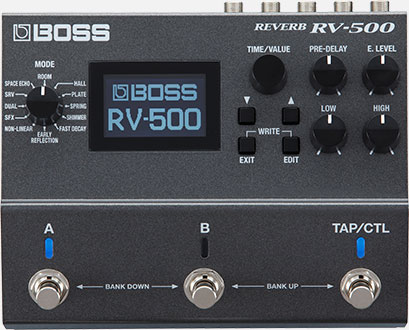
The RV-500 is the best value in deep reverb processing. Twenty-one reverb modes with two engines running simultaneously covers everything the BigSky does — and then some — for $180 less. The modulation routing options let you put a tremolo on the reverb tail, or a pitch shifter, or a filter, creating sounds you can't get from the BigSky. MIDI implementation is full and comprehensive.
The sound quality is excellent. The algorithms are smooth and natural, and the stereo field is wide. Two footswitches plus tap tempo make it practical for live use. The trade-off versus the BigSky is interface: the RV-500 uses a small LCD screen and menu navigation, which is less immediate than the BigSky's knob-per-function layout. For players who can invest the time to learn the interface, the RV-500 punches above its price.
Pros
- 21 reverb modes, two engines simultaneously
- Onboard modulation routing
- Full MIDI implementation
- Excellent sound quality
- $179 cheaper than BigSky
Cons
- Menu-based interface less intuitive than BigSky
- Larger footprint than simple reverbs
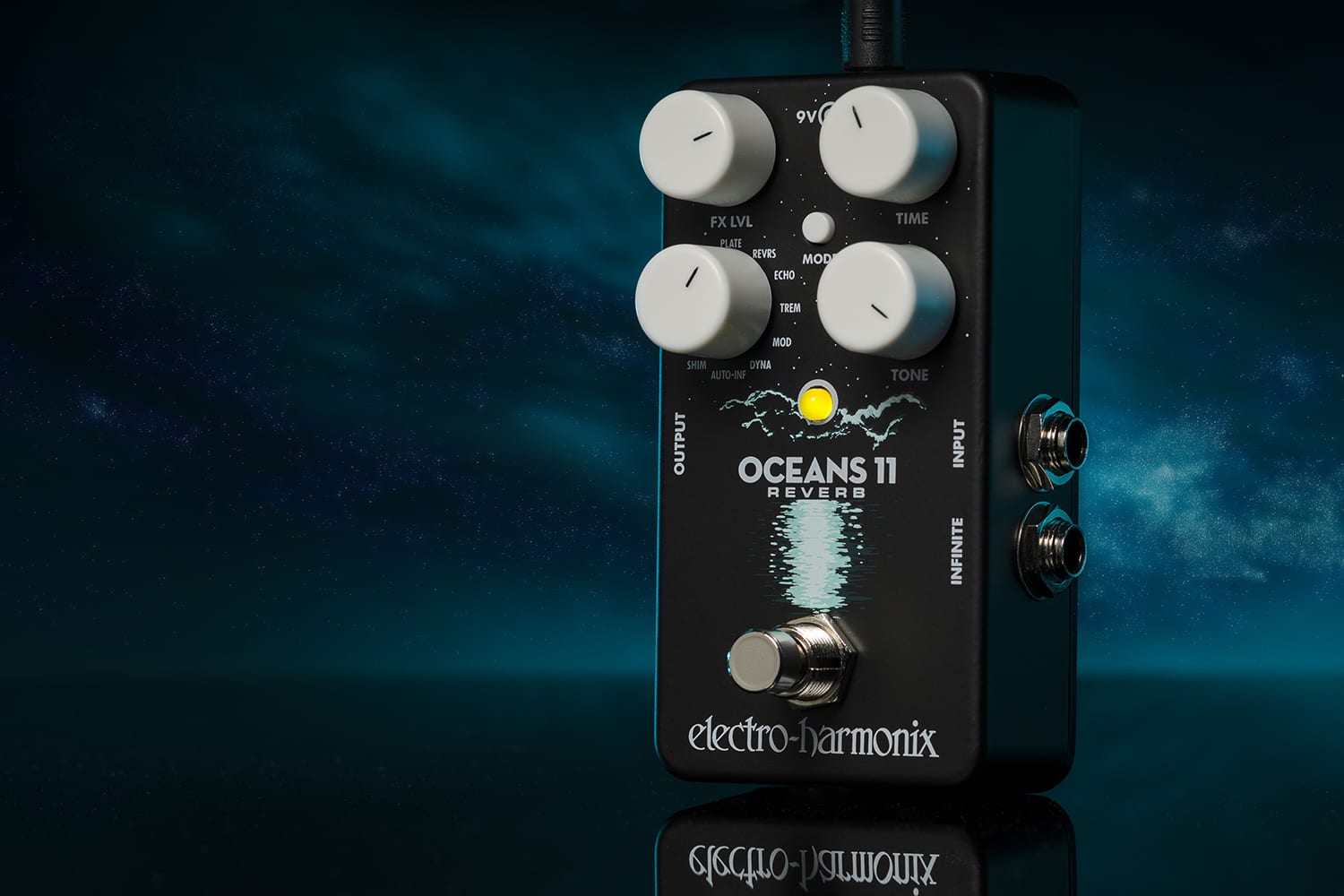
The Oceans 11 packs eleven reverb types — including shimmer, dynamic, magneto, and a very convincing spring — into a compact enclosure for around $155. Each mode has a secondary set of controls accessed by holding the Blend knob, which doubles the parameter count without doubling the physical space. An expression pedal jack adds realtime control of decay or mix. The result is a remarkably deep pedal for the price.
Sound quality is excellent for a pedal in this price range. The shimmer mode is one of the best available under $200, and the spring mode captures the classic amp reverb character convincingly. The secondary parameter system takes a little getting used to, but once it's in your muscle memory the Oceans 11 is fast to use live. This is the reverb to buy if you want serious depth without the BigSky price tag.
Pros
- 11 reverb types including excellent shimmer
- Secondary controls double parameter access
- Expression pedal jack
- Stereo I/O
- Excellent value at ~$155
Cons
- Secondary parameter system requires learning
- Controls are slightly cramped
The RV-6 is the ideal reverb pedal for a guitarist who wants quality sounds in a no-hassle package. Eight modes cover room, hall, plate, spring, modulate, dynamic, shimmer, and +Delay, and all of them sound good enough for professional use. The interface is a single knob and a mode selector — there's no menu navigation, no secondary modes, no learning curve. Dial in a reverb, use it, done.
The dynamic mode is a standout feature: it senses your picking dynamics and ducks the reverb level when you play hard, pushing it up in the gaps. This keeps reverb from cluttering your tone during busy playing while still adding ambience in quieter passages. Boss build quality is what it is — this pedal will work for 20 years without complaint. At around $145 it's the practical choice for most working guitarists.
Pros
- 8 practical reverb modes
- Simple knob-per-function interface
- Dynamic mode is genuinely useful live
- Boss reliability and build quality
- Stereo I/O
Cons
- Less deep than Oceans 11 or BigSky
- Shimmer mode is basic compared to competitors
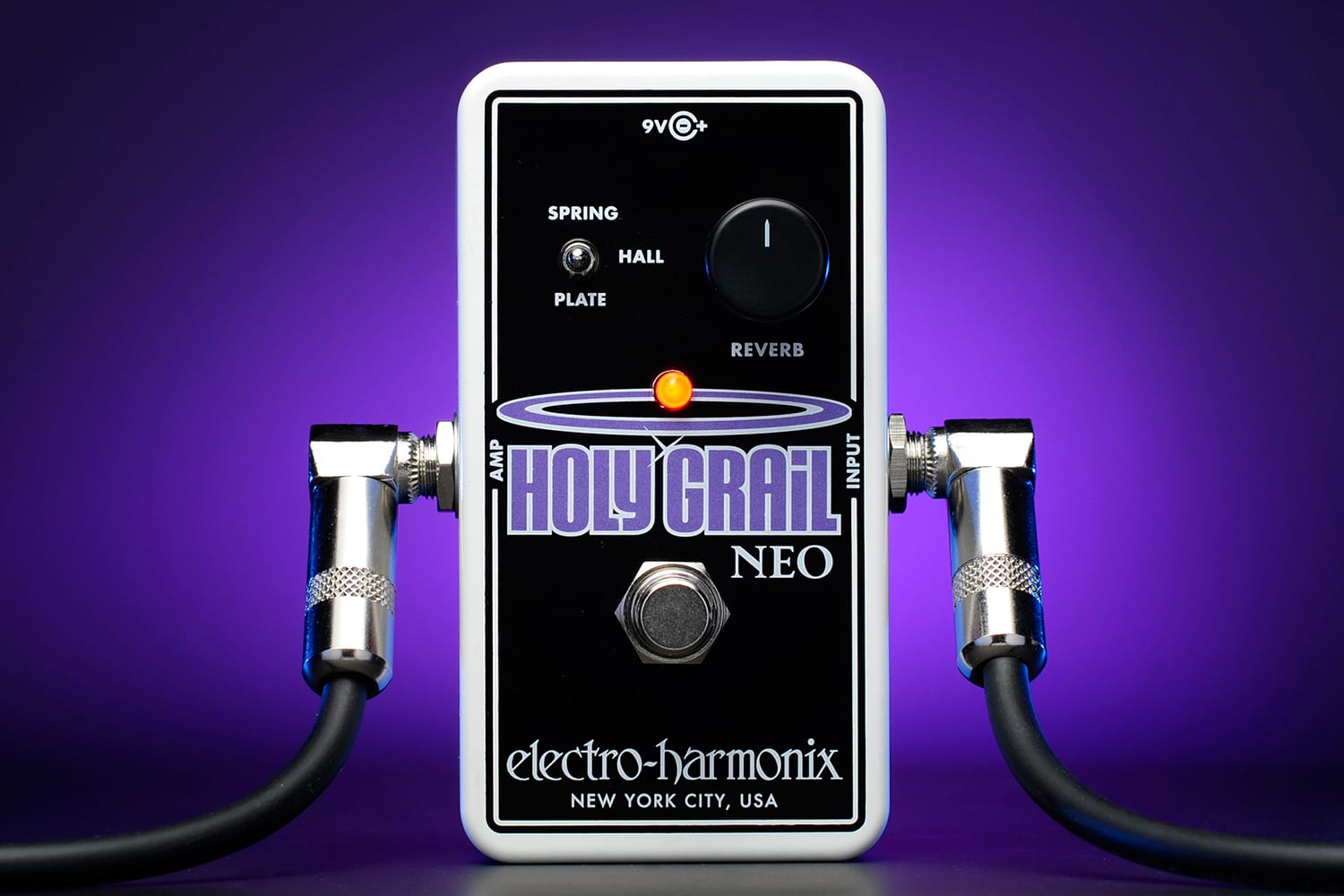
The Holy Grail Neo is the simplest reverb pedal worth buying. Three modes — Spring, Hall, and Flerb (a flanger/reverb hybrid) — controlled by a single knob. That's it. No menu, no secondary modes, no learning required. Spring and Hall both sound musical and natural at moderate settings. The Flerb is a quirky experimental mode that sounds unlike anything else, and it's either going to be your favorite thing or something you ignore entirely.
At under $90 it's the most affordable quality reverb on the market. The Spring mode is warm and splashy in a way that works for country and classic rock, and the Hall mode adds a convincing ambience without eating your tone. If you just want "a little reverb on top" without any complexity, the Holy Grail Neo is the obvious answer. It's also the right choice for a player who's new to using reverb and doesn't yet know what they want.
Pros
- Dead simple — three modes, one knob
- Good spring and hall sounds
- Very affordable at under $90
- Compact, lightweight
- True bypass
Cons
- Only three modes
- No stereo I/O
- Flerb mode is niche
- No pre-delay or damping control
Which Reverb Pedal Should You Buy?
For a working guitarist who wants to cover all the bases without menu-diving, the Boss RV-6 is the easy recommendation. For players who want more depth at a fair price, the EHX Oceans 11 punches above its price and has excellent algorithms. If you want the absolute best and budget isn't the priority, the Strymon BigSky is the reference standard. The Boss RV-500 hits a sweet spot of depth and value at $300. And if you just want simple, good reverb that works every time, the Holy Grail Neo is the answer.
Frequently Asked Questions
How many reverb types do I actually need?
Fewer than most reverb pedals offer. If you mainly want hall and maybe spring, a simple pedal like the EHX Holy Grail Neo or Boss RV-6 covers it. Only go deeper into a pedal like the Strymon BigSky if you actually plan to use shimmer, modulated, or specialty algorithms.
Where does reverb go in my signal chain?
Reverb almost always goes last, after delay, modulation, and gain pedals, right before your amp. Putting reverb earlier in the chain makes everything after it sound smeared and washed out.
Do I need a reverb pedal if my amp already has reverb?
Not necessarily, if your amp's built-in reverb sounds good to you. A dedicated pedal makes more sense if you want more reverb types than a simple spring circuit, want to blend or control decay more precisely, or your amp's reverb is weak or noisy.
How do I know which reverb type fits my music?
Not every reverb type fits every genre. Our Tone Finder factors in your style and influences to tell you whether you need a simple spring reverb or something deeper like the BigSky.