Strymon BigSky Review: Still the Reverb King in 2026?
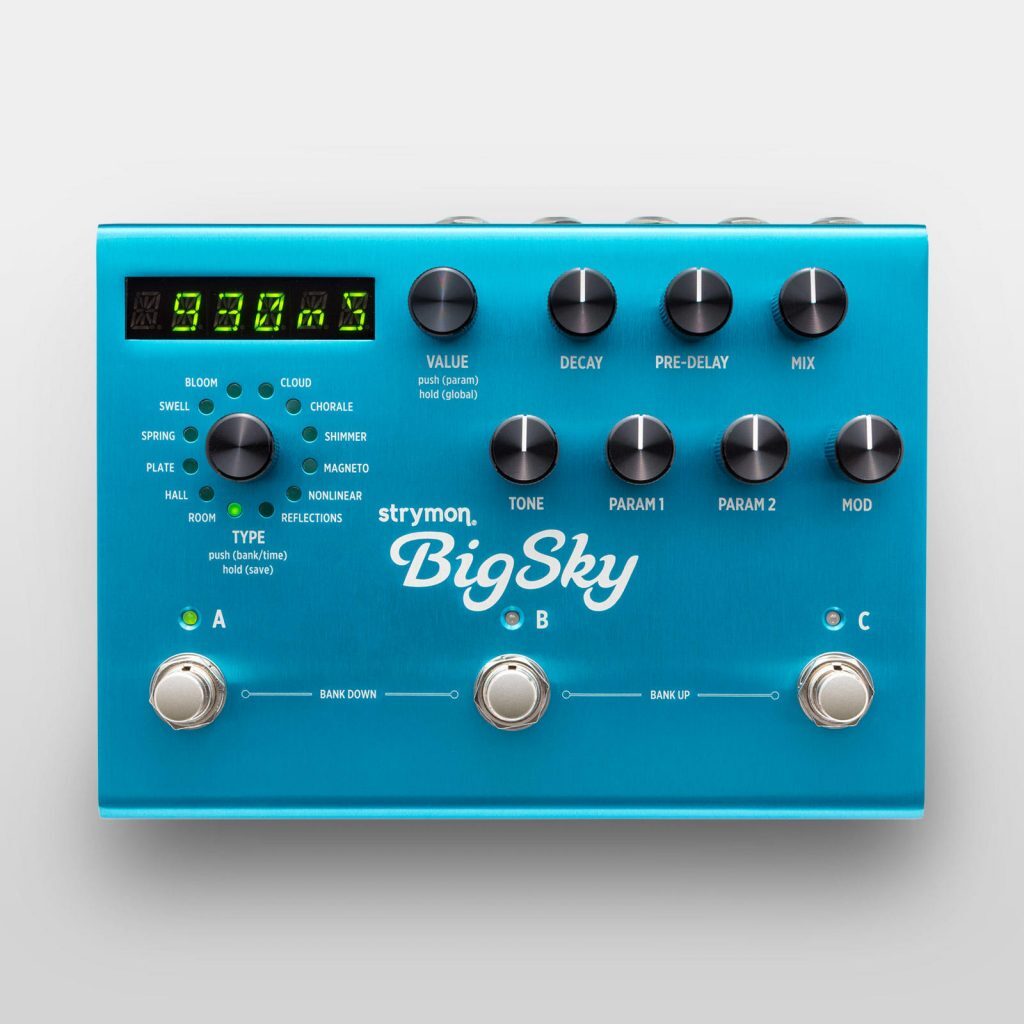
At $479, the Strymon BigSky is one of the most expensive guitar pedals in mainstream production. That price needs justifying, and after four weeks of use across recording sessions, rehearsals, and live gigs, we've got a strong opinion on it. Spoiler: the price is mostly justified, but it's not for everyone, and there are scenarios where spending less makes more sense.
Overview and Build Quality
The BigSky is a dual-footswitch reverb pedal with 12 reverb algorithms, three main knobs (Decay, Mix, Pre-Delay), three parameter knobs (Value A, Value B, Value C) whose job changes per algorithm, and a bank of switches for tone, modulation, and mode selection. It's a lot of controls for a stompbox, and the learning curve is real.
Build quality is Strymon's whole thing: thick aluminum enclosure, solid and well-spaced knobs, switches with a satisfying click. After four weeks of regular use including live shows, nothing rattled, shifted, or acted up. This pedal is built to last.
It runs on 9V power but draws 300mA, so it needs its own isolated power supply output, which matters when you're planning your pedalboard. The stereo ins and outs are a real advantage for studio use and for anyone running a wet/dry setup.
The 12 Reverb Types: What Each One Is Actually Good For
Room: The best-sounding room reverb in any pedal format. Natural, three-dimensional, responsive to pick attack. This alone is worth owning the pedal for studio work.
Hall: Classic concert hall decay. Works well for clean, spacious lead tones. Can get washy on rhythm playing at longer decay times.
Plate: Warm, dense reverb modeled on vintage studio plate reverbs. Excellent on clean electric and acoustic guitar. One of the most used settings in recording contexts.
Spring: Arguably the most convincing digital spring reverb you can buy. The modeled spring behavior (drip, splatter, decay) is exceptionally realistic. Better than a lot of hardware spring tanks for live use where moving the amp around is a problem.
Swell: Volume-swell reverb that creates ambient pad-like swells behind your playing. Inspired by the Eno/Fripp tape-loop technique. Genuinely beautiful for solo and ambient work.
Bloom: The reverb grows after the note fades, almost the reverse of how reverb normally behaves. Unusual, immersive, and great for post-rock and ambient styles.
Cloud: Infinite, dense reverb that sustains indefinitely. Not useful for most playing, but for creating textural pads and drone backgrounds it's spectacular.
Chorale: Adds a slow-attack choral shimmer to the reverb tail. The shimmer effect has been somewhat overused since the BigSky popularized it, but done subtly on a clean guitar it's still magical.
Shimmer: Pitch-shifted reverb that adds octave harmonics to the decay. The BigSky's shimmer is a lot better than most implementations: cleaner, more musical, and less "obviously digital."
Magneto: Tape echo-style reverb modeled on reel-to-reel tape machines. The warble and saturation controls are excellent, and this one ends up getting used more than you'd expect in rehearsal.
Nonlinear: Gated, reverse, and unconventional reverb shapes. The gated reverb setting sounds exactly like an 80s drum machine reverb applied to guitar, which is either a selling point or a reason to avoid it depending on your taste.
Dual: Two reverbs in series or parallel. This gets deep fast, letting you combine, say, a spring reverb with a plate reverb for hybrid tones. Genuinely useful for studio work, a lot to manage live.
Live vs Studio Use
Live: The BigSky is an excellent live reverb, but the complexity means you need to prep beforehand. The 300 preset slots are the feature that matters most here: set your sounds at home, recall them on stage. Trying to tweak the BigSky under stage lighting is rough. The MIDI implementation (in/out via TRS) lets you go deep with MIDI switchers for patch recall, which makes it a lot more practical live. Without preset management it's a frustrating gigging pedal. With it, it's exceptional.
Studio: The BigSky is just as much a studio tool as a live pedal. The stereo operation, the quality of the Room and Plate algorithms, and the ability to dial in exact pre-delay and decay values make it genuinely competitive with outboard hardware reverb. For recording guitarists who want professional reverb quality without rack gear, this is it.
Pros
- 12 exceptional reverb algorithms
- Studio-quality sound in pedal format
- 300 presets with MIDI recall
- Stereo in/out
- Outstanding build quality
- Spring reverb rivals hardware tanks
Cons
- Very expensive at $479
- Complex UI, real learning curve
- 300mA draw needs dedicated power output
- Large footprint
- Overkill for players who just need one or two reverb sounds
Strymon BigSky Score: 9.4 / 10
The BigSky earns its price if you're a working musician who'll genuinely use multiple reverb types, if you record and need studio-quality reverb in pedal format, or if you rely on precise preset recall for live shows. If you only need spring reverb for a Fender-style clean tone, save your money and get the BlueSky for $250 or the Boss RV-6 for $150. But for players who want the best reverb pedal you can buy, the BigSky is still the reference standard, and it has been since 2012.