Best Multi-Effects Pedals 2026: Ranked for Sound, Usability, and Value
Multi-effects processors have come a long way. What once meant compromised tones and clunky interfaces now means studio-grade amp modeling, hundreds of effects, and intuitive signal routing in a single floor unit. Players who once swore by individual pedals are quietly building setups around multi-effects units — and for good reason: the best modern multi-FX sound genuinely excellent and travel far more easily than a loaded pedalboard.
We evaluated five multi-effects processors across amp models, effects quality, ease of use, and live performance practicality. From the flagship Helix LT to the budget-friendly GT-1, there's a unit on this list for every player and budget.
Multi-FX vs Individual Pedals: Which Is Right for You?
The debate between multi-effects units and individual pedals isn't about which sounds better — it's about which workflow fits your playing. Individual pedals excel when you know exactly the tones you need, want physical controls for each effect, and prioritize the specific character of boutique pedals. A Strymon reverb sounds like a Strymon reverb, and no multi-effects unit models it perfectly.
Multi-effects units excel when you need many different tones, play multiple styles, travel regularly, or are still exploring what sounds you actually need. Modern amp modeling in units like the Helix LT is genuinely good enough for professional use — and the convenience of having 500 presets at your feet, instantly recallable, is real. Many professional players now use multi-effects as their primary live rig and keep boutique pedals only for studio work.
The best approach for many players is a hybrid: a multi-effects unit for amp modeling, delay, reverb, and modulation, with a few favorite individual pedals (compressor, boost, specific drive pedal) in the loop.
What to Look for in a Multi-Effects Unit
- Amp modeling quality: This is the most critical factor. Poor amp modeling makes everything sound processed and fake. Great amp modeling makes you forget you're not playing through a real amp.
- Effects quality: Reverbs, delays, and modulation in good multi-FX units now rival dedicated boutique pedals. Check that the effects you use most are modeled well, not just included as afterthoughts.
- Routing flexibility: Can you build complex parallel signal paths? Run effects in a custom order? Use 4-cable method with a real amp? More routing flexibility = more creative and practical options.
- Interface and programmability: How quickly can you build and edit patches? A good interface makes you spend time making music; a bad one makes you spend time digging through menus.
- Connectivity: USB audio interface capability lets you record direct to your DAW. XLR outputs for FOH connections. Effects loop for integrating individual pedals. MIDI for expanded control.
- Footswitch layout: Live performance depends on having enough footswitches to switch presets, activate individual effects, and control expression in real time.
The Rankings

The Line 6 Helix LT is the most sonically impressive multi-effects unit at its price point. Helix amp modeling is widely regarded as the best available — the HX engine captures the feel and response of tube amplifiers with remarkable accuracy. Over 70 amp models, 40+ cab simulations, and 100+ effects give you comprehensive coverage of virtually any tone you might need.
The LT's routing engine is one of its standout features: up to 32 blocks with fully flexible parallel and series routing lets you build signal chains as complex as any boutique pedalboard. The large color scribble strips above each footswitch show exactly what's assigned where at a glance. USB audio interface capability means you can record directly to your DAW with studio-quality sound. At around $899, the Helix LT is a significant investment — but it replaces a pedalboard worth several times that price and sounds better than most of them.
Pros
- Best-in-class HX amp modeling
- 32 blocks with full parallel routing
- Color scribble strip display for each footswitch
- USB audio interface built in
- Comprehensive connectivity (XLR, MIDI, effects loop)
Cons
- ~$899 price point
- Large and heavy for touring
- Learning curve on full routing flexibility
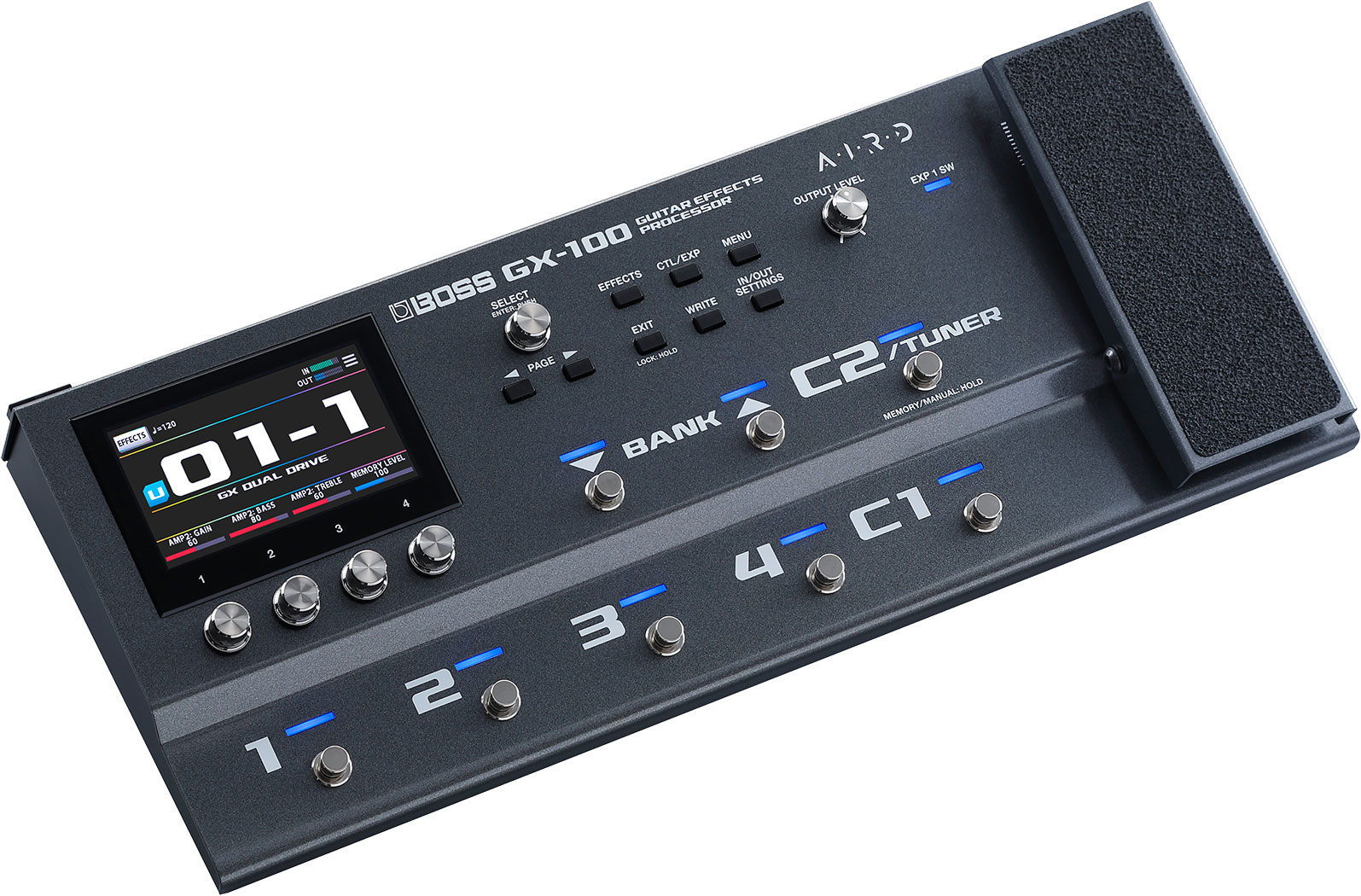
The Boss GX-100 represents Boss's current state-of-the-art in multi-effects: AIRD (Augmented Impulse Response Dynamics) amp modeling that captures the feel of real amps with impressive accuracy, combined with a color touchscreen interface that makes patch editing significantly more intuitive than traditional knob-and-button navigation. The touchscreen approach is genuinely faster for building and editing patches.
Over 150 effects and 60+ amp models cover the tonal spectrum comprehensively. The dual DSP architecture means you can run more complex signal chains simultaneously without hitting processor limits. 4-cable method support lets you integrate your existing amp into the signal chain. USB interface capability rounds out the professional feature set. At around $499, the GX-100 is meaningfully less expensive than the Helix LT while offering excellent sound quality. For players who want professional-grade tones without the Helix price, it's the logical choice.
Pros
- AIRD amp modeling with great feel and response
- Intuitive color touchscreen interface
- Dual DSP for complex signal chains
- 4-cable method support
- USB audio interface built in
Cons
- Touchscreen can be harder to use live with gloves
- Fewer amp models than Helix LT
- ~$499 mid-range investment
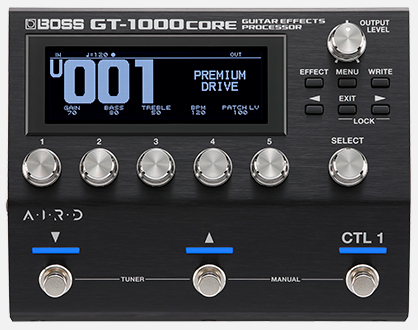
The GT-1000CORE occupies a unique niche in the multi-effects market: it's designed specifically to integrate with a real amp rather than replace it. The CORE version of the GT-1000 removes the full amp modeling section in favor of a streamlined effects processor that's optimized for front-of-amp or effects-loop use. The result is a unit that brings GT-1000 quality effects to players who already have an amp they love and don't want to abandon it.
AIRD processing delivers excellent modulation, delay, reverb, and dynamic effects. The compact size makes it easier to fit on a pedalboard alongside individual pedals. At around $449, it costs almost as much as the full GT-1000, which can seem counterintuitive — but you're paying for the same DSP quality in a format optimized for hybrid rigs. For the player who wants to upgrade their pedalboard's modulation and time-based effects en masse without committing to a standalone multi-FX rig, the GT-1000CORE is purpose-built for exactly that scenario.
Pros
- GT-1000 quality effects for amp integration
- Compact form factor for pedalboard use
- Excellent modulation, delay, and reverb quality
- AIRD dynamics processing
- Works brilliantly in 4-cable method
Cons
- No standalone amp modeling (requires real amp)
- ~$449 price for effects-only unit
- Less standalone than full GT-1000
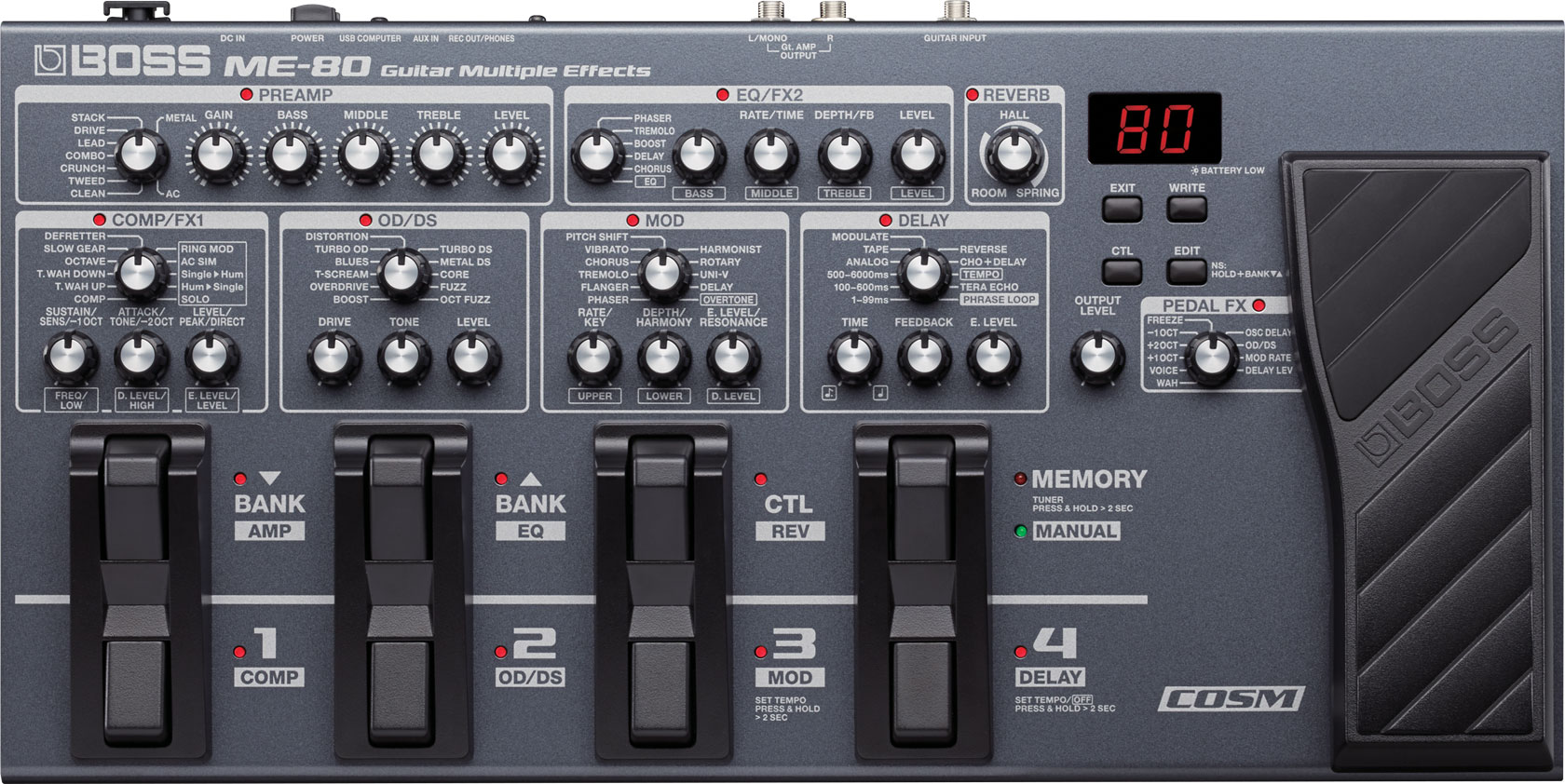
The Boss ME-80 takes a deliberately different approach to multi-effects: instead of menus and screens, it uses dedicated knobs for each effect category arranged in a logical signal chain order. Comp, OD/DS, Amp, Equalizer, NS (noise suppressor), Modulation, Delay, and Reverb — each has its own physical controls. Tweaking your tone is as immediate as reaching down and turning a knob, with no menu diving required.
This interface philosophy makes the ME-80 uniquely approachable for players transitioning from individual pedals. The learning curve is minimal. The sound quality is very good for the price, and the analog-style operation is genuinely fast on stage. At around $299, it's more affordable than the GX-100 and GT-1000CORE. Battery power capability (6 AA batteries) is a practical bonus for buskers and rehearsal spaces without convenient power. If you want to step into multi-effects without abandoning the feel of turning knobs, the ME-80 is the most natural transition.
Pros
- Knob-per-function, no menu diving
- Intuitive for pedalboard veterans
- Battery-powered operation (6 AA)
- Good sound quality at mid-price
- Simple enough to learn quickly
Cons
- Less routing flexibility than screen-based units
- Older amp modeling technology
- No USB audio interface
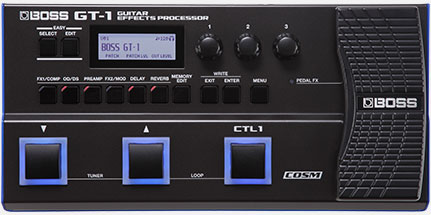
The Boss GT-1 punches significantly above its weight class. For around $149, you get Boss's COSM amp modeling, over 100 effects, looper, tuner, and USB recording capability in a unit that fits in a backpack. The GT-1 is the first multi-effects unit many players buy, and it's a better starting point than its price suggests.
COSM modeling in the GT-1 isn't as sophisticated as the AIRD processing in the GX-100 or GT-1000, but for practice, recording demos, and casual gigging it's entirely adequate. The battery operation (4 AA) adds portability. The footprint is small enough to throw in a gig bag with your guitar. For a beginner or intermediate player who wants to explore hundreds of tones without making a large financial commitment, the GT-1 is an excellent starting point. You'll likely outgrow it eventually, but what you learn about your own preferences will make you a better buyer when you're ready to upgrade.
Pros
- Exceptional value at ~$149
- 100+ effects plus amp models
- Ultra-compact and lightweight
- USB recording capable
- Battery-powered (4 AA)
Cons
- Older COSM modeling (not AIRD quality)
- Small display can be hard to read
- Limited routing flexibility
Which Multi-Effects Unit Should You Buy?
The Line 6 Helix LT is the clear winner for players who want the best — its amp modeling, routing, and build quality are in a class of their own at this price. For players who can't justify $899, the Boss GX-100 delivers modern AIRD quality with an excellent touchscreen interface at $499. The Boss ME-80 wins for players who want immediacy and analog-style control. The Boss GT-1000CORE solves the hybrid amp-plus-effects problem beautifully. And the Boss GT-1 is the starting point that won't let you down while you figure out what you actually need.
Frequently Asked Questions
Should I get a multi-effects unit instead of individual pedals?
It depends on what you value. A multi-effects unit like the Helix LT gives you more sounds, easier travel, and total recall of your settings. Individual pedals give you more hands-on control and, for many players, a more satisfying feel to dial in tones.
Can I use a multi-effects unit with a real tube amp?
Yes. Units like the Boss GT-1000CORE are actually designed for that, sitting in the effects loop or front of a real amp rather than replacing it with amp modeling. If you want to keep your amp but add modern effects and routing, that's the better fit than a full modeler like the Helix LT.
Is the Boss GT-1 good enough for gigging?
Yes, for most gigging situations. It's the budget option on this list, but it runs the same GT-series processing as the pricier units in a more compact form. You give up some connectivity and control surface, not core sound quality.
Will a multi-effects unit actually replace my whole pedalboard?
For most players, yes, at least on the effects side of the chain. If you want to see exactly what you'd be replacing before you commit, lay out your current pedals in our Pedalboard Builder and compare it against what a unit like the Helix LT covers.