Best Overdrive Pedals 2026: Top Picks for Every Budget
Overdrive is the most crowded category in guitar gear, full stop. There are hundreds of options, anywhere from $30 Boss clones to $400 boutique builds, and most of the marketing copy sounds identical. "Warm. Transparent. Touch-sensitive." Sure. They all say that.
This roundup is built on actual playing time, not spec sheets. Each pedal below got tested through a Fender Deluxe Reverb, a Marshall JCM800, and a Vox AC15, with both single-coil and humbucker guitars. This isn't every overdrive on the market. It's the ones actually worth your money right now.
What Makes a Great Overdrive Pedal
Before we get into specific pedals, let's talk about what you're actually listening for. A great overdrive does a few things well. It adds harmonic saturation without burying your pick attack, it responds to how hard you're playing instead of squashing everything flat, and it sits in a mix without fighting for space.
People love arguing about "transparent" overdrive, so let's settle it. A truly transparent overdrive, like a clean boost into a pushed amp, sounds very different from a mid-focused drive like a Tube Screamer. Neither one is better. They just do different jobs. A Tube Screamer pushes mids and cleans up beautifully on single notes. A transparent drive leaves your tone stack alone and works better for full chords and busier voicings.
The Top 5 Overdrive Pedals
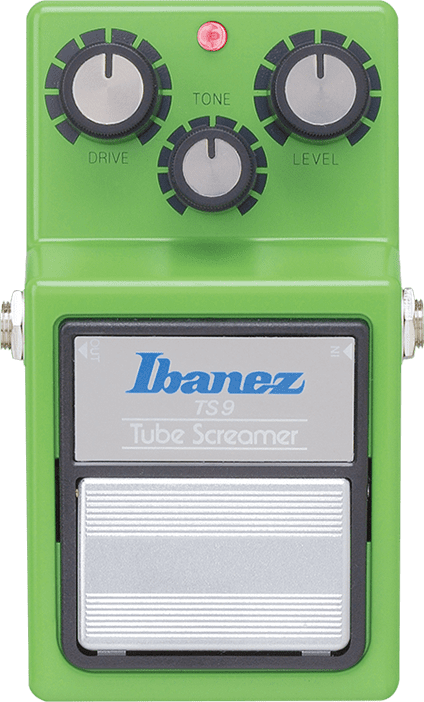
The TS9 has been the reference point for overdrive pedals since the early 1980s, and it earns that every time you plug one in. There's a mid bump around 700Hz baked into the circuit, and that's what gives it the signature "singing" quality on lead lines. It's not a transparent overdrive and it's not trying to be one. It's a tone shaping tool that makes single-coil guitars bloom through a tube amp.
Where it shines: push it into an amp that's already starting to break up and the TS9 acts like a second gain stage, tightening the low end and stretching out sustain without getting flabby. It's also one of the best "always on" pedals if you're running into a clean amp and want consistent breakup without having to ride your guitar's volume knob all night.
Where it falls short: humbuckers can get muddy when you push the gain. The low end thins out on bass-heavy rigs. And if you actually want transparent drive, look elsewhere. That mid hump is a character choice, not a flaw, but it's there whether you want it or not.
Pros
- Iconic, proven tone
- Cleans up beautifully with volume knob
- Excellent with single-coils into tube amps
- Durable, road-ready build
Cons
- Mid hump isn't for everyone
- Thins out low end
- Buffered bypass (not true bypass)
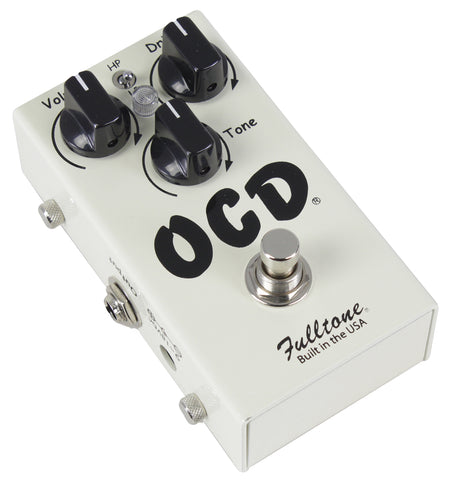
The OCD lives in the gap between overdrive and distortion, with a gain range wide enough to cover everything from a mild crunch to full-on rock distortion. The HP/LP switch is the feature that matters most here. HP mode is tighter and more present, LP mode is warmer and more compressed. Run humbuckers into a Marshall stack with HP mode on and you get one of the best crunchy rhythm tones you can buy in a stompbox.
Unlike the Tube Screamer, the OCD stays pretty flat across the EQ, so it plays nice with a wider range of amps. It's also one of the few overdrives that actually sounds good at bedroom volume. It doesn't need amp breakup to come alive.
Pros
- Wide gain range
- Works well with humbuckers
- HP/LP switch adds versatility
- Sounds good at any volume
Cons
- Can be harsh in the high-mids at high gain
- Less touch-sensitive than TS-style drives
- Not true bypass on older versions
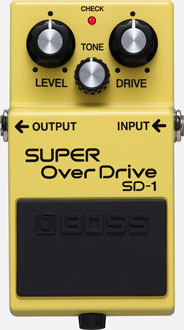
People dismiss the SD-1 as a cheaper TS alternative, and that's selling it short. The asymmetrical clipping gives it a different harmonic flavor than the TS9, more open and less compressed at lower gain. It's one of the best sub-$60 pedals ever made and it's been on professional pedalboards since 1981.
Stack it at lower gain into a slightly dirty amp and the SD-1 has a rawness that plenty of more expensive pedals try and fail to copy. It's not as refined as the TS9, but for some styles, harder blues and classic rock especially, that rawness is exactly what you want.
Pros
- Excellent value
- Asymmetric clipping sounds less polished in a good way
- Built to last
- Stacks beautifully
Cons
- Less refined than TS9 at higher gains
- Buffered bypass
- Very similar to TS, not meaningfully different for some players

If you want your core tone left alone with just a little more grit and sustain, the Morning Glory is the answer. It's one of the most transparent overdrives at any price. It doesn't push mids, doesn't thin out the low end, doesn't add color you never asked for. It just makes your amp sound like it's working a little harder.
The bright switch adds a touch of top end shimmer without turning harsh, and the gain range is usable from one end to the other. The V4 added a clipping switch that gets it closer to Marshall style breakup at higher settings. At $159 it's a real investment, but it's the kind of pedal that stays on a board for years.
Pros
- Highly transparent, preserves your core tone
- Works with any amp or guitar
- True bypass
- Excellent dynamics and touch sensitivity
Cons
- Expensive for what appears simple
- Lower gain ceiling than OCD or TS
- Bright switch can be too much on bright amps
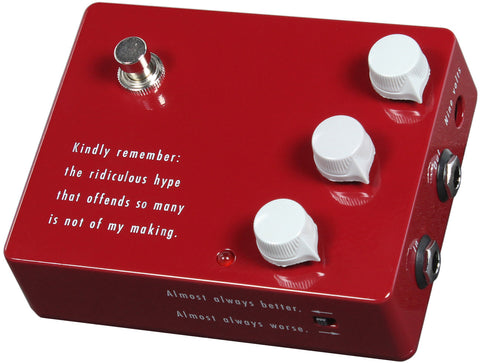
The KTR is the modern production version of the legendary Klon Centaur, and yes, it sounds as good as everyone says. What sets it apart is how it interacts with your amp's natural character. At lower gain it acts as a transparent boost that somehow makes everything sound more "right." Push the gain higher and it gives you a smooth, singing overdrive that never gets shrill or squashed.
At $270 and up it's hard to recommend without some hedging. But play one through a good amp and you'll get why it sits at the top of this list. It's the kind of pedal you buy once and never sell. If you want to explore the broader Klon family, we've got a dedicated Klon clone roundup that covers seven options from $65 to $270.
Pros
- Exceptional dynamic response
- Works beautifully as a clean boost or overdrive
- Premium build quality
- True bypass with internal buffer option
Cons
- Very expensive
- Gain range is modest, not a high-gain pedal
- Hard to find in stock
Which Overdrive Should You Buy?
For most players, the Ibanez TS9 remains the best starting point. It is proven, versatile, and you can find one used for under $60. If you want something more transparent that won't color your tone, the JHS Morning Glory is the best in class. If budget is the priority, the Boss SD-1 is genuinely excellent for the money. And if you want the best overdrive pedal available at any price and can stomach spending $270 on a stompbox, the Klon KTR delivers something the others don't.
Frequently Asked Questions
What's the difference between overdrive and distortion?
Overdrive pushes your amp into natural-sounding breakup and responds to how hard you pick. Distortion clips the signal more aggressively and stays consistent no matter how you play, so it sounds more compressed and aggressive while overdrive stays touch-sensitive.
Is the Ibanez TS9 still worth buying in 2026?
Yes. The TS9's mid-forward voicing is still the reference point most other overdrives get compared to, and it remains one of the best values in the category. You can find one used for well under $100.
Do I need a transparent overdrive or a colored one?
It depends on your amp and pickups. If your amp already has a tone you like and you just want more gain, go transparent with something like the JHS Morning Glory. If you want the pedal to shape your tone with extra mids or more sustain, a colored drive like the TS9 or SD-1 does more of the work for you.
How do I know which overdrive fits my playing style?
The right pick depends on your amp, guitar, and genre more than any spec sheet. Answer a few questions in our Tone Finder and we'll recommend a full pedal chain, overdrive included, built around your actual rig.