MXR Phase 90 Review: Still the Best One-Knob Phaser?
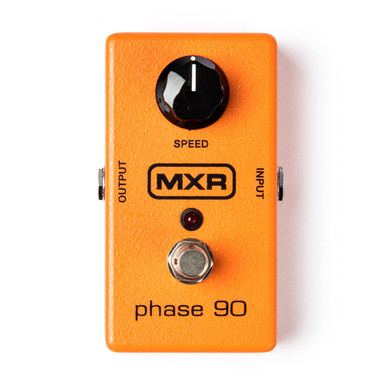
The MXR Phase 90 is one of the most recognizable guitar pedals ever made. That bright orange enclosure with a single Speed knob has been on professional pedalboards since 1974. Eddie Van Halen, David Gilmour, Eric Johnson, and plenty of others built it into the core of their sound. At around $80 new, it's also one of the most affordable genuinely great pedals you can buy.
But "classic" doesn't always mean "current best." We tested the standard Phase 90, the Script Logo reissue, and the EVH Phase 90 to answer the questions everyone actually has: which version sounds best, what's the real difference between script and block logo, and is any of it worth caring about?
History and Versions
The original Phase 90 was designed by Don Buchla and built by MXR starting in 1974. The earliest versions had a script logo on the enclosure and a specific circuit topology. In the late 1970s, MXR switched to a block logo and tweaked the circuit to cut manufacturing costs, with the R28 resistor change being the biggest modification. Block logo versions have a slightly brighter, more aggressive phase effect. Script logo versions are warmer and more subtle.
Current production includes the standard Phase 90 (block logo circuit), the Script Logo reissue (the original warmer circuit), and the EVH Phase 90 (block logo with an added "Script" switch and EVH graphics). Understanding these differences is essential to buying the right one.
How It Sounds
The Phase 90 gives you a four-stage phasing effect with a single speed control. Unlike more complex phasers (Moog MF-103, EHX Small Stone) there's no depth, feedback, or resonance control. You get the effect in its purest, most musical form. The phase sweep is smooth and organic, especially at slower speeds where it adds a subtle, moving quality to clean guitar that just works immediately.
At slower speeds (7 to 9 o'clock on the Speed knob) the Phase 90 adds depth and movement to clean chords without being distracting. This is its best use case, the classic "Van Halen clean tone" setting. At medium speeds it becomes a more obviously present effect. At fast speeds it gets into rotary-cabinet territory and works well on sustained chords.
The Phase 90 plays great with overdrive and distortion. Running a phaser after an overdrive adds width and movement to lead tones without smearing your pick attack. It's a widely used setup, and the Phase 90 handles it better than most phasers do.
Script Logo vs Block Logo: What's the Real Difference
This is the most asked question about the Phase 90, so here's a direct answer: the script logo version is warmer and more subtle, the block logo version is brighter and more pronounced. The difference is audible but not dramatic, and neither one is objectively better. It comes down to your rig and how you play.
Choose the Script Logo if: You play clean or lightly driven tones, your amp is already bright, or you want phaser as a subtle texture rather than a prominent effect. The warm, smooth character of the script circuit is less likely to fight with the rest of your signal chain.
Choose the Block Logo if: You play with more gain, your amp is darker-voiced, or you want the phaser to be more present and audible in a mix. The brighter character cuts through better at higher gain levels.
The EVH Phase 90: Worth the Premium?
The EVH Phase 90 costs around $110, about $30 more than the standard version, and adds a "Script" switch that toggles between block and script circuit voices. It also has EVH's signature graphics, which either does something for you or doesn't. The extra switch is genuinely useful though: you get both circuit characters in one pedal and can flip between them on the fly.
If you're undecided between script and block, the EVH version is the practical answer. If you know which circuit you want, save the $30 and buy the appropriate standard version.
Pros
- Exceptional organic phase character
- Simple one-knob control
- Works beautifully with overdrive
- Affordable at ~$80
- Compact, durable enclosure
- Decades of professional use and trust
Cons
- Only one control, no depth or feedback adjustment
- Buffered bypass
- Script vs block confusion for first-time buyers
- Less versatile than more complex phasers
MXR Phase 90 Score: 8.9 / 10
The MXR Phase 90 remains the best entry point into phaser pedals and one of the best values in all of guitar effects. The single Speed knob forces you to find the right tempo for your music instead of tweaking forever, and the circuit sounds genuinely exceptional: warm, organic, and musical in a way more complex phasers don't always pull off. Buy the script version for subtlety, the block version for presence, or the EVH version if you want both. Any of them earns a permanent spot on your pedalboard.