Best Noise Gate Pedals 2026: Silence the Hum, Keep the Tone
Noise gates are the unsung heroes of the pedalboard. They don't add anything to your tone — their job is purely subtractive, eliminating the hum, hiss, and interference that accumulates in a high-gain signal chain. When they work transparently, you don't notice them at all. When they're absent, every pause in your playing fills with noise. Getting the right noise gate is about finding the one that disappears completely while doing its job flawlessly.
This list covers the best noise gate and noise suppressor pedals available, plus two compressor options that provide meaningful noise management as part of their compression function. If you play high-gain, use single-coil pickups, or run a lot of pedals, at least one of these belongs on your board.
Noise Gates Explained: Gate vs Suppressor vs Expander
A noise gate is the most aggressive approach: it monitors your signal level and when that level drops below a set threshold, it cuts the signal completely to silence. The result is total silence between notes. This works well for high-gain playing where notes are percussive and there are clear gaps, but can sound unnatural for ambient or clean playing where notes decay slowly.
A noise suppressor (like the Boss NS-2) is more sophisticated: it reduces the noise floor gradually rather than cutting to complete silence. The result is more natural-sounding, especially for sustained notes and slower musical passages. The signal fades smoothly rather than cutting abruptly at the threshold.
A downward expander (like what the MXR Smart Gate uses) works by making quiet signals quieter proportionally rather than applying a fixed gate. This is the most transparent approach and sounds the most natural, preserving note decay and sustain while effectively eliminating noise.
The distinction matters for your playing style. Metal players who play tightly with clear gaps between riffs can use aggressive gating. Ambient players, clean players, or anyone with significant sustain needs a more subtle suppression or expansion approach.
What to Look for in a Noise Gate
- Transparency: The best noise gate is one you can't hear working. It should eliminate noise without affecting tone, sustain, or the natural decay of notes. Test with sustained notes and chord rings-outs — if the gate chops them off artificially, it's set too aggressively or the design is too blunt.
- Threshold control: Fine-grained threshold adjustment lets you dial in the exact trigger point for your specific noise floor. Too high and the gate cuts into your playing; too low and it doesn't mute noise effectively.
- Decay/release time: How quickly does the gate close after the signal drops below threshold? Fast decay sounds choppy and unnatural; slow decay allows notes to ring out naturally before the gate closes. The best gates let you adjust this.
- Effects loop (send/return): The Boss NS-2 and EHX Silencer both include effects loops that let you place noisy pedals inside the gate circuit. This is crucial for high-gain setups — your distortion and fuzz pedals generate the most noise, and putting them in the gate's loop gives you precise control over exactly what gets suppressed.
- Placement flexibility: Some gates work best at the beginning of the chain, others at the end, others in the amp's effects loop. Understanding placement gives you more effective noise control.
The Rankings

The Boss NS-2 is the most widely used noise gate pedal in the world, and it has been for thirty years. The reason is simple: it works. The NS-2 uses Boss's BOSS DETECTION circuit that senses your guitar signal and intelligently adjusts the suppression to maintain natural decay and sustain while eliminating noise. The Threshold and Decay controls give you precise adjustment, and the buffered bypass maintains signal integrity throughout.
The send/return effects loop is the NS-2's most powerful feature. By placing your high-gain pedals inside the loop, the NS-2 can use your clean dry signal (which doesn't have the gain-generated noise) as the detection signal while gating the noisy wet signal. This "keyed" approach is dramatically more effective than simple inline gating and is the professional technique used by metal and hard rock players worldwide. At around $109, the NS-2 is the definitive noise suppressor. If you have any noise problems at all, start here.
Pros
- Industry-standard reliability and effectiveness
- Send/return loop for keyed suppression of noisy pedals
- Natural-sounding suppression, not abrupt gating
- Threshold and Decay controls
- Boss build quality — indestructible
Cons
- ~$109 — not the cheapest option
- Buffered bypass
- Can still clip sustain if Threshold is set too high
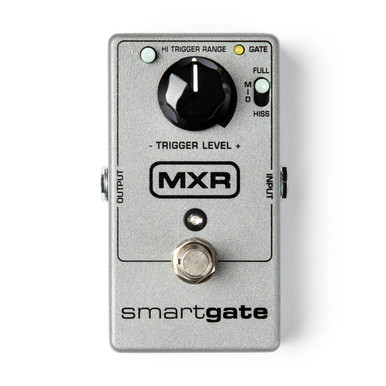
The MXR Smart Gate M135 is distinguished by its three-mode gating system: Hard, Medium, and Hiss. Hard mode is a traditional aggressive gate for high-gain, tight playing. Medium mode is a hybrid approach suitable for most playing styles. Hiss mode is specifically optimized for filtering high-frequency noise — single-coil hum, fluorescent light interference, and similar hiss-dominant noise sources — without affecting the signal in ways that affect sustain or tone.
The single Threshold knob keeps operation simple: dial it until the noise disappears between notes, and you're done. True bypass maintains signal path purity when the gate is off. At around $99, the Smart Gate is priced competitively with the NS-2 without the NS-2's loop functionality, but the three-mode system gives more focused noise control for specific problems. Players with primarily hiss-type noise (single-coil players, ambient players with quiet, hiss-prone setups) often find the Hiss mode dramatically more musical than anything the NS-2 can achieve.
Pros
- Three intelligent gate modes (Hard, Medium, Hiss)
- Hiss mode uniquely useful for single-coil noise
- True bypass
- Simple single-knob threshold control
- Very transparent — hard to notice it's working
Cons
- No effects loop for keyed suppression
- Less flexible than NS-2 for complex gain chains
- ~$99
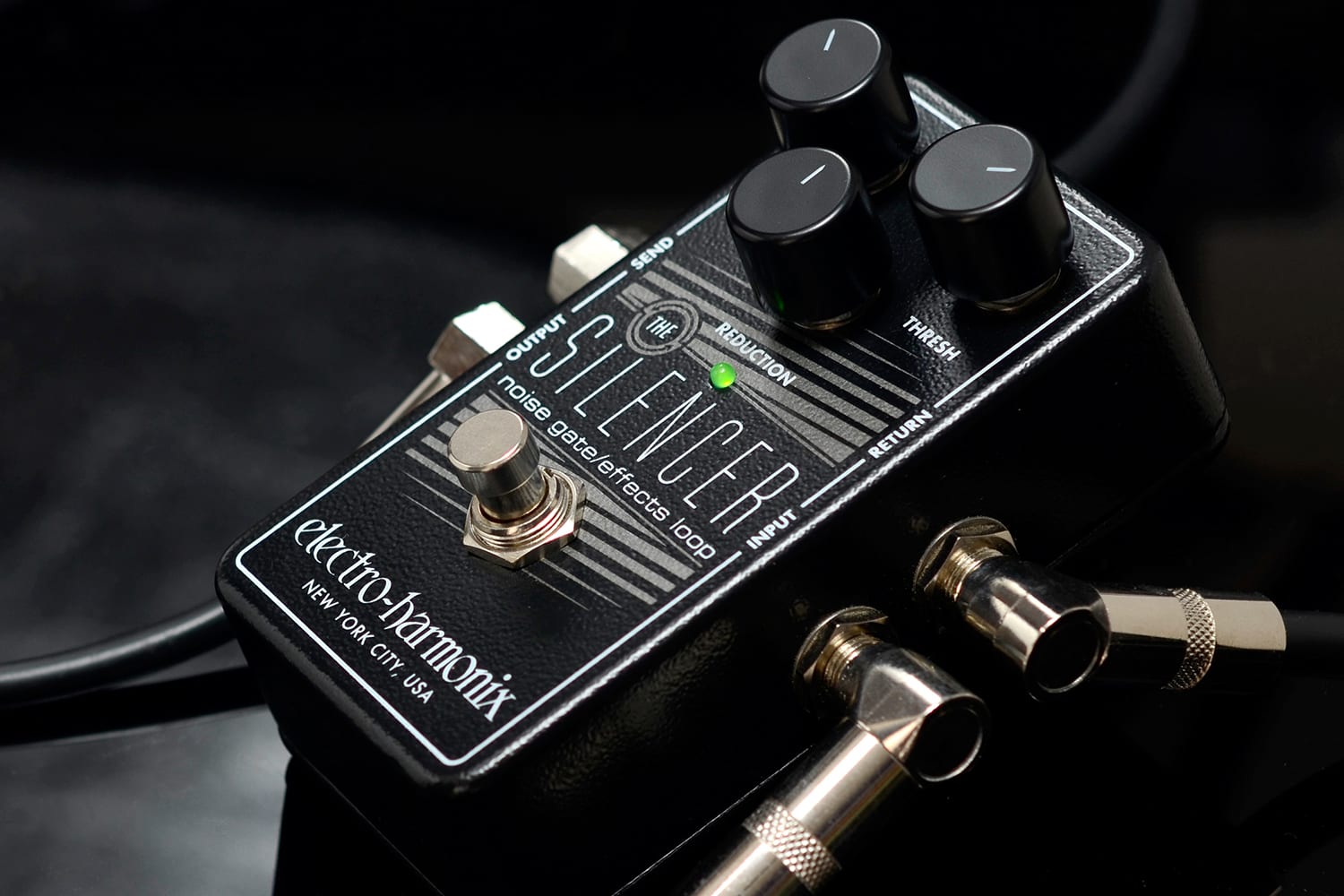
The EHX Silencer is the most direct alternative to the Boss NS-2: it includes an effects loop for keyed suppression and offers threshold, attack, and release controls. The attack control is something the NS-2 lacks — it determines how quickly the gate opens when signal exceeds the threshold, allowing for more precise control of the onset characteristic. This makes the Silencer more adjustable for different playing styles and noise situations.
True bypass keeps the signal path clean when the Silencer is disengaged. Threshold, Attack, and Release controls give comprehensive adjustment of the gate behavior. The effects loop allows the same keyed suppression technique used with the NS-2. At around $79, the EHX Silencer is notably cheaper than the NS-2 while offering more controls and true bypass. It's the smart buy for players who want NS-2-style functionality with true bypass and attack time control at a lower price. Build quality is solid EHX standard — not Boss-level bombproof, but plenty adequate for most players.
Pros
- Effects loop for keyed suppression (like NS-2)
- True bypass
- Attack and Release controls (more than NS-2)
- More affordable than NS-2 (~$79)
- Very effective noise elimination
Cons
- Build quality slightly below Boss standard
- Less widespread reputation than NS-2
- Can be less intuitive to dial in initially
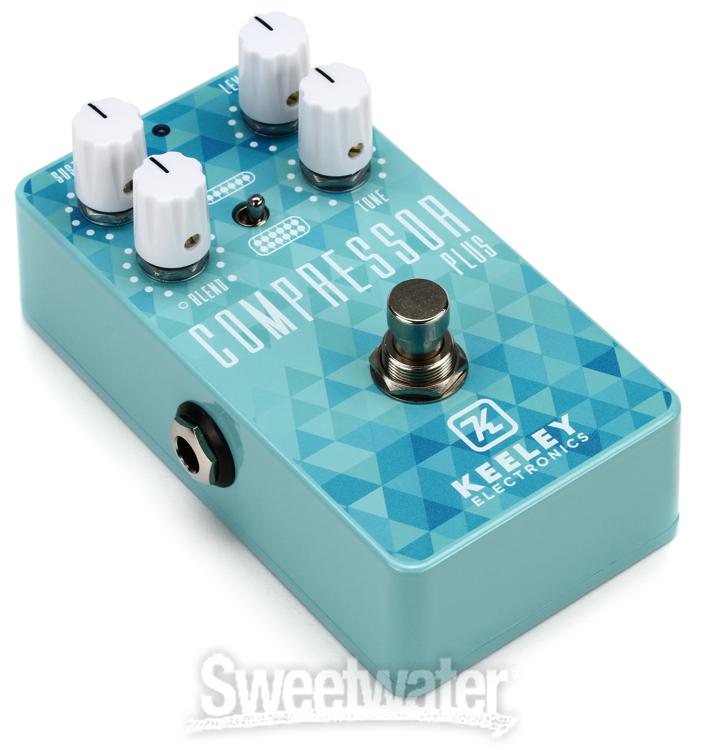
The Keeley Compressor Plus takes a different approach to noise management: rather than gating the noise, compression naturally reduces the noise floor as a byproduct of the compression process. When a compressor reduces the dynamic range of loud signals, it also proportionally reduces quiet noise — a property known as "noise floor suppression." The Keeley Compressor Plus implements this with studio-grade optocoupler compression that is simultaneously one of the finest-sounding compressors available and an effective noise reducer for moderate noise situations.
Four controls — Sustain, Level, Blend, and Tone — give comprehensive adjustment. The Blend control is particularly useful: it mixes your dry signal back with the compressed signal, preserving some natural dynamics while retaining compression benefits. True bypass. At around $149, the Keeley Compressor Plus is more expensive than a dedicated noise gate, but it does two jobs: compression (adding sustain, evenness, and presence to your signal) and noise reduction. For players who want a compressor anyway, it's a compelling choice that eliminates the need for a separate noise gate in many situations.
Pros
- Studio-quality optocoupler compression
- Natural noise floor reduction as compression byproduct
- Blend control for parallel compression
- True bypass
- Replaces both compressor and light noise gate
Cons
- ~$149 — more expensive than dedicated noise gates
- Not a substitute for aggressive gating in high-gain rigs
- Noise reduction is a benefit, not the primary function
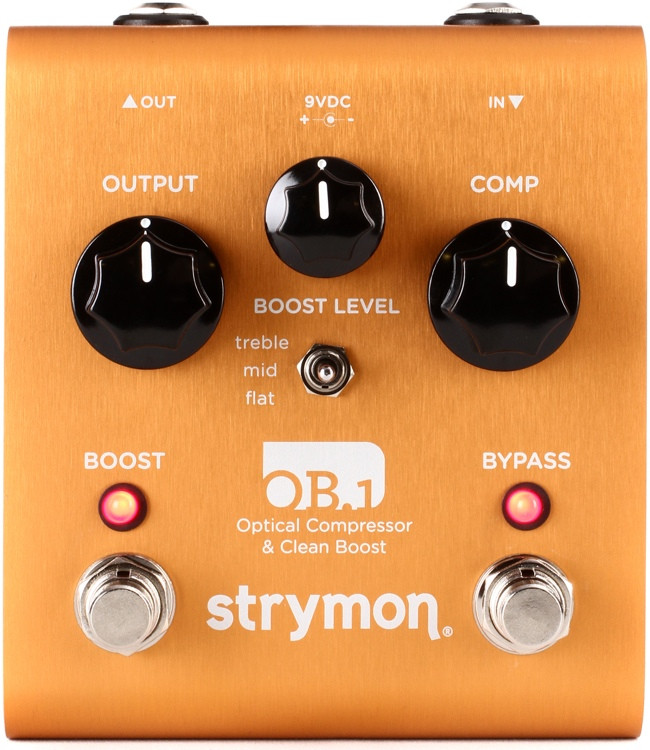
The Strymon OB.1 is the audiophile's compression-plus-boost solution. Using a high-quality optical compression circuit modeled after vintage studio compressors, the OB.1 delivers remarkably transparent compression that adds sustain and evenness to your signal without the "pumping" or "breathing" artifacts that plague lesser compressors. A separate clean boost section adds up to 20dB for solo boosts, making the OB.1 a dual-function pedal that replaces both a compressor and a boost on your board.
Like the Keeley Compressor Plus, the OB.1's compression naturally reduces the noise floor as a byproduct. For players whose noise issues stem from single-coil pickups or a moderately noisy signal chain, this level of compression-based noise management is often sufficient without requiring a dedicated gate. At around $199, the OB.1 is premium, but it does two jobs with Strymon's signature audio quality. Players who want the cleanest possible compression and a built-in boost should seriously consider this pedal as a noise-management-plus tool that improves their tone rather than just silencing noise.
Pros
- Ultra-transparent optical compression
- Built-in clean boost (up to +20dB)
- Natural noise floor reduction
- Strymon's signature sound quality
- Replaces compressor and boost pedals
Cons
- ~$199 premium price
- Not a substitute for dedicated gating in high-gain rigs
- No effects loop for keyed suppression
Which Noise Gate Should You Buy?
The Boss NS-2 is the definitive noise suppressor for high-gain players — its effects loop and natural suppression character make it the professional standard for a reason. Players who want true bypass and more control should consider the EHX Silencer, which delivers similar loop-based functionality at a lower price. The MXR Smart Gate M135 is the best choice for single-coil players who need targeted hiss reduction rather than aggressive gating. And the Keeley Compressor Plus and Strymon OB.1 offer premium compression with meaningful noise management built in — ideal for players who want to improve their tone while addressing noise simultaneously.
Frequently Asked Questions
Do I need a noise gate if I don't play high-gain metal?
Probably not urgently. Noise gates matter most for high-gain and hot pickup setups where hiss and hum are audible between notes. Clean and light-overdrive players usually don't need one, though a transparent gate like the MXR Smart Gate won't hurt.
Where should a noise gate go in the signal chain?
Right after your highest-gain pedal, typically after distortion or fuzz and before time-based effects like delay and reverb. That placement kills noise at its loudest point without gating the tail of your delay or reverb trails.
Will a noise gate cut off my sustain?
A poorly set one will. Set the threshold too aggressively and it chokes notes as they decay naturally. The Boss NS-2 and MXR Smart Gate both let you dial in threshold and decay carefully enough to avoid that if you take the time to set them up.
How do I know if noise is actually the gap in my rig?
Hum and hiss get blamed on cheap cables or bad pickups more often than the real culprit, which is usually gain staging. Run your setup through our Pedal Blindspot tool to see if a noise gate, or something else, belongs in your chain.